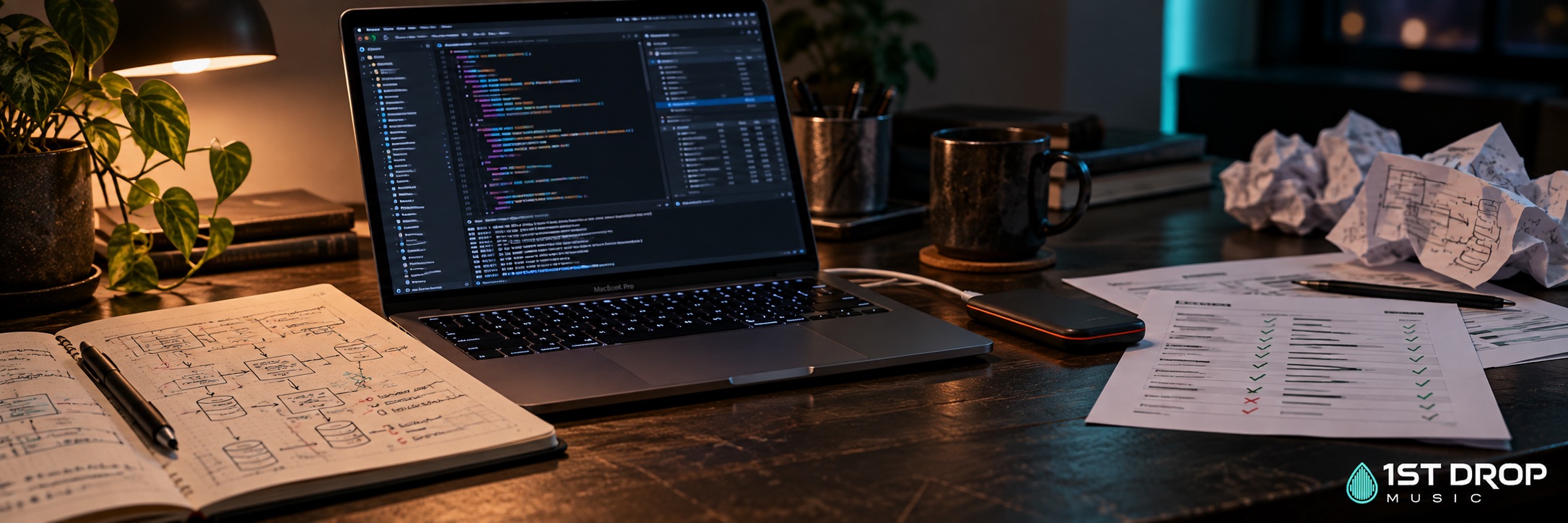
“Vibe coding” can sound effortless.
The phrase often evokes a simple picture: describe an idea to an artificial-intelligence assistant, receive a finished application, and publish it. From the outside, software built with AI can appear to materialize from a handful of prompts.
That has not been my experience.
AI-assisted development can dramatically accelerate parts of the process, but building a dependable system still demands expertise, research, architecture, judgment, testing, correction, and long hours of focused work.
Mission HQ and the larger 1st Drop Music and Free the Line ecosystem represent hundreds—and, at this point, likely approaching thousands—of hours of development. They were not generated in an afternoon. They have been built from the ground up through database work, systems research, content migration, interface design, comparison with existing platforms, technical implementation, testing, governance, and continuous refinement.
Vibe coding is part of that story. It is not the beginning of it, and it is certainly not the entire story.
The Experience Came Before the AI
Before generative AI became part of my workflow, I had already spent decades working in technology.
I hold degrees in Web Design and Development, and my professional experience includes web systems, WordPress, managed hosting, customer support, project delivery, digital operations, interface design, content architecture, and technical problem-solving.
I have also spent years building the connected creative ecosystem behind 1st Drop Music: artist identities, websites, music catalogs, editorial platforms, digital assets, publishing systems, promotional channels, and the relationships among them.
That history matters.
AI did not introduce me to website architecture, databases, publishing workflows, or user experience. It gave me a new way to apply knowledge accumulated through decades of designing, developing, supporting, managing, and improving digital systems.
The technology is new. The foundation beneath the work is not.
Vibe Coding Is a New Interface for Existing Expertise
At its simplest, vibe coding means using natural language to direct software development.
Instead of manually producing every line of code, a person can describe the desired behavior, provide context, establish constraints, evaluate the implementation, and continue refining it through conversation.
That is powerful—but the quality of the result still depends on the quality of the direction.
A person must understand the problem well enough to describe it. They must recognize when the proposed solution is incomplete. They must identify which assumptions are unsafe, which relationships are missing, and which apparently minor choices could create larger operational problems.
Natural language may become the interface, but expertise remains the engine.
For someone without relevant experience, AI can produce a convincing screen that feels complete. An experienced builder is more likely to see what is still missing: authentication, permissions, validation, source history, error recovery, accessibility, record ownership, structured data, publication controls, and maintainable relationships between systems.
The difference is not simply the prompt. It is what the person behind the prompt knows to examine.
You Do Not Type an Idea and Receive a Finished Business System
One of the most misleading ideas surrounding AI development is that a complex application emerges fully formed after someone describes it.
A prototype might. A real business system does not.
A prompt can generate an interface. It cannot independently determine every business rule, identify every authoritative source, understand every downstream dependency, or accept responsibility for every decision.
Even a seemingly straightforward request—“build a system for managing articles”—raises deeper questions about destinations, authorship, image permissions, canonical URLs, structured data, changes after publication, source evidence, duplicate detection, approvals, and integration failures.
Those questions do not disappear because AI can generate code quickly. They become more important because rapid generation makes it easier to create complexity before the underlying rules are understood.
What Building Mission HQ Has Actually Required
Mission HQ grew from the operational needs of a real, interconnected creative organization. The system manages information across artists, releases, recordings, playlists, videos, podcasts, merchandise, articles, assets, websites, descriptions, relationships, and discovery data.
Creating it has required researching and comparing existing systems; designing databases and relationships from the ground up; importing and reconciling years of information; distinguishing canonical facts from destination-specific copy; connecting assets to the entities they represent; establishing governance workflows; creating multiple description formats; designing SEO and structured-data systems; testing authentication, permissions, validation, and error handling; and rebuilding features when an initial approach did not serve the larger system.
Some work moves quickly. Other problems require days of investigation and repeated revisions. A feature may appear simple after it is completed precisely because considerable effort went into resolving the complexity beneath it.
Researching Existing Systems Without Merely Copying Them
Building from the ground up does not mean pretending no previous system has useful ideas.
Part of responsible development is studying how established content-management systems, digital-asset libraries, music databases, publishing tools, customer-management platforms, and project applications solve recurring problems.
The goal is not to reproduce another product blindly. It is to understand why certain patterns exist, where existing tools fall short, and which ideas can be adapted responsibly.
Mission HQ combines familiar concepts in a way that serves the particular needs of the 1st Drop Music and Free the Line ecosystem. AI can help analyze these patterns. It cannot decide which tradeoffs are appropriate without detailed human context.
From a Working Prototype to a Trustworthy Platform
Generating something that works once is relatively easy. Building something that can be trusted repeatedly is much harder.
A production system must handle incomplete data, conflicting records, expired authentication, broken links, missing files, failed uploads, duplicate imports, unexpected behavior, and changing requirements.
It must make mistakes correctable, preserve record history, protect sensitive information, avoid damaging downstream destinations, and remain understandable as it expands.
This is where decades of experience in support, hosting, web development, project delivery, and operations become invaluable. Real systems are defined not only by what they do when everything goes right, but by how clearly and safely they behave when something goes wrong.
AI Accelerates Work; It Does Not Eliminate It
AI can shorten the distance between an idea and a testable implementation. It can generate initial structures, explain code, propose database models, locate inconsistencies, suggest tests, transform content, document workflows, and identify possible solutions to failures.
Those abilities are enormously useful. However, acceleration should not be confused with automation of the entire responsibility.
Generated code must still be reviewed. Interfaces must still be tested. Business rules must still be confirmed. Information must still be researched and reconciled. Architectural decisions must still account for future use.
Sometimes AI saves hours. Sometimes an AI-assisted approach creates a new problem that takes hours to diagnose. Sometimes the best result comes from rejecting the initial proposal and rebuilding the feature around a better understanding of the need.
Vibe coding changes the mechanics of the work. It does not make meaningful work disappear.
The Human Role Is Product Direction, Verification, and Accountability
Responsible vibe coding requires active human leadership.
The human participant must determine which problem is worth solving, what success means, which sources can be trusted, what should remain private, how users should experience the workflow, what risks are acceptable, what must be tested, and when the implementation is ready.
This is more than casually approving what the AI produces. It is an iterative discipline of explaining, examining, challenging, testing, correcting, and improving.
The AI participates in the process. The human owns the outcome.
Technical Literacy Still Matters
Vibe coding does not make technical education or literacy obsolete.
A builder may not need to manually write every function, but they should understand enough about databases, environments, dependencies, authentication, permissions, APIs, deployment, testing, security, logging, and recovery to ask meaningful questions.
They also need information architecture, user experience, accessibility, project management, content governance, operational planning, technical communication, change management, and systems thinking.
My education in Web Design and Development and decades of professional technology experience shape how I evaluate AI-generated work. They help me see the distance between a visually convincing result and a dependable implementation.
A Labor of Love—and a Serious Technical Undertaking
Mission HQ is a labor of love. It exists because I care about preserving creative work, representing artists accurately, building stronger connections among projects, and giving a small organization the capabilities to manage a large and growing body of information.
But “labor of love” should not be confused with effortless work.
The platform has required long days, late nights, difficult decisions, failed approaches, repeated testing, and an enormous amount of detailed attention. The surrounding websites and content ecosystem began years before the current generation of AI tools existed.
The technology assists the labor. It does not erase it.
A Practical Standard for Responsible Vibe Coding
Before accepting an AI-assisted feature, I ask whether I can explain the problem it solves, whether its behavior matches the business rule, whether more than the ideal path was tested, whether data ownership and permissions are clear, whether mistakes are reversible, whether hidden consequences exist elsewhere, whether the implementation is maintainable, and whether I am willing to take responsibility for the result.
If the answer to one of those questions is no, the feature is not finished.
What Comes Next
Mission HQ will continue expanding beyond its current music, media, publishing, and business-management capabilities.
Those expansions will benefit from faster AI tools. They will also require more planning, testing, judgment, and hands-on work.
Vibe coding gives experienced people a remarkable new way to build. Its greatest value is not that it makes expertise unnecessary. It allows expertise to move more directly from understanding into implementation.
That is how Mission HQ is being built: not through a few prompts, but through decades of experience, hundreds upon hundreds of hours of work, and a sustained commitment to making the system genuinely useful.
Learn more about my professional work at Bear Cole Professional, explore the technology and implementation work of Free the Line, and follow the broader creative ecosystem through 1st Drop Music.