The short answer is no.
Mission HQ can perform work that overlaps with a customer relationship management system, and CRM capabilities can become part of it. But describing Mission HQ as another CRM misses both its foundation and its larger purpose.
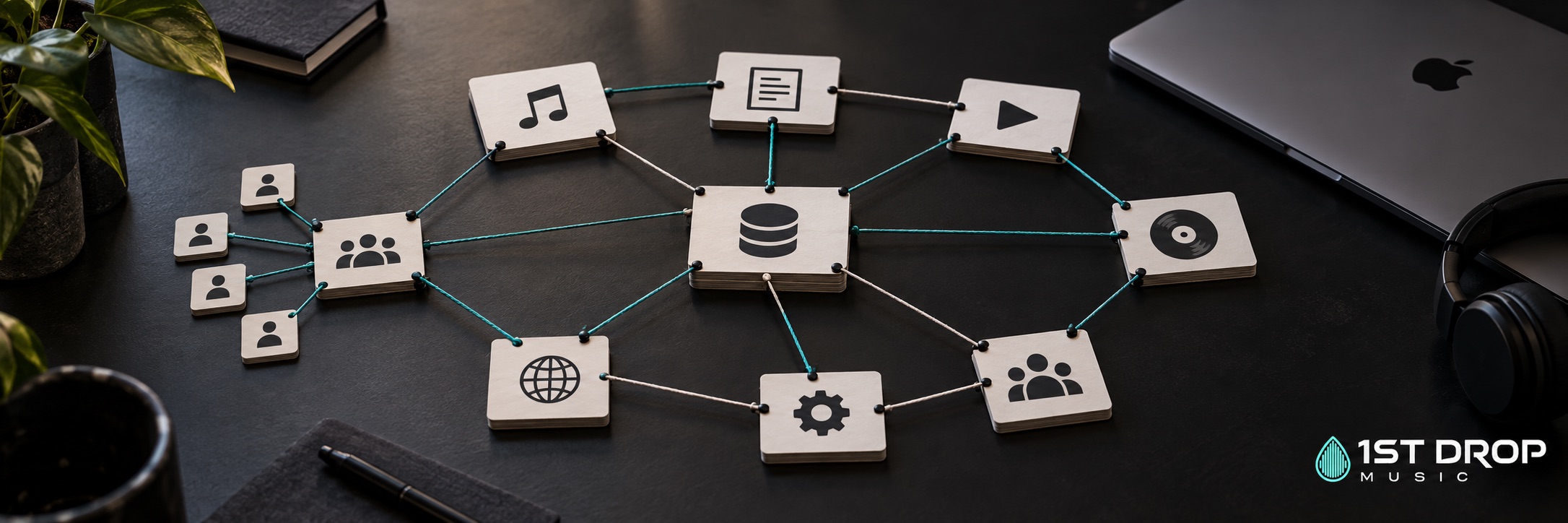
A traditional CRM organizes relationships with customers and prospects. Mission HQ was built to organize the canonical truth of an interconnected creative and business ecosystem—then make that truth usable across websites, publishing, operations, assets, releases, people, products, evidence, and emerging AI workflows.
What a CRM is designed to manage
Salesforce describes CRM as technology for managing a company’s relationships and interactions with customers and potential customers. HubSpot similarly centers CRM on customer data, sales activity, marketing, service, and relationship history.
That is valuable work. A well-designed CRM can keep contacts, organizations, conversations, opportunities, tasks, and customer activity from becoming scattered across inboxes and spreadsheets.
But the customer is normally the center of the model.
For many creative organizations, that is only one part of the truth they need to manage.
The problem was larger than customer relationships
Mission HQ grew from a different operational problem.
1st Drop Music and the connected projects around it include artists, releases, recordings, artwork, credits, lyrics, videos, playlists, DJ mixes, articles, products, websites, press information, venues, services, people, organizations, and years of source material.
Each item can appear in several places. A release belongs to an artist, contains recordings, uses assets, carries credits, appears on multiple sites, feeds social and press copy, and may connect to products, videos, playlists, and future stories.
If every destination owns a separate copy, the ecosystem gradually fills with contradictions. A biography changes on one site but not another. A credit is corrected in a release record but remains wrong in a press page. An asset loses its context. A new channel requires the same information to be rewritten from memory.
The central question was not, “How do we track customers?”
It was, “How do we establish what is true, preserve where that truth came from, connect everything that depends on it, and publish the right version everywhere it belongs?”
Canonical data changes the architecture
Mission HQ was built around canonical entities.
A canonical record is the authoritative representation of something the organization knows: an artist, release, recording, person, organization, asset, article, site, playlist, video, product, service, or other meaningful object.
That record is not merely a row in a generic contact database. It carries the structure appropriate to the thing it represents. It can also maintain governed relationships to other records.
A recording can connect to its songwriter, producer, performers, release, artwork, identifiers, and source evidence. An article can connect to the relevant artist, project, service, site, and structured topics. A product can connect to the creative work and brand it represents. A person can participate in several relationships without becoming the center of the entire system.
This creates a connected information model rather than a collection of unrelated forms.
One truth can support many destinations
Canonical data becomes especially useful when it serves multiple endpoints.
The same underlying release may need a long artist-site story, a concise label description, an Instagram caption, a press summary, structured data for search engines, and internal operational notes. Those outputs should not be identical, but they should agree on the facts.
Mission HQ separates the durable truth from the destination-specific presentation.
That distinction allows each site and channel to retain its own voice while drawing from the same governed foundation. It also makes corrections safer: the organization can identify where information is used and update dependent material deliberately instead of guessing which copies exist.
Governance is part of the product
Mission HQ does not treat every automation as harmless.
Some changes can be generated or prepared safely. Others should remain drafts. Public publishing, destructive changes, identity decisions, permissions, and uncertain factual claims require human judgment.
That is why governance, review states, provenance, and evidence are not afterthoughts. They are part of the operating model.
The goal is not to let AI make every decision. The goal is to let automation handle appropriate repetition while people remain responsible for meaning, accuracy, risk, and voice.
Provenance makes the system more trustworthy
Creative and business information often comes from many sources: an old WordPress export, a distributor record, a contract, a spreadsheet, a media file, a public platform, a conversation, or a correction made years later.
Mission HQ is being built to preserve more than the final field value. Where appropriate, it can retain the source, evidence, history, and relationships that explain why the information should be trusted.
That becomes increasingly important as AI participates in research, migration, description writing, classification, and publishing preparation. A useful intelligent system needs to distinguish verified facts from inference and generated language.
Without provenance, automation can multiply uncertainty. With provenance and review, it can help people navigate a complicated body of knowledge.
A CRM can be one capability inside Mission HQ
Mission HQ can absolutely benefit from CRM functions.
Contacts, organizations, communication history, opportunities, partnerships, venues, press relationships, clients, and service engagements all belong in a complete operational environment. Those capabilities can connect naturally to the wider model.
The difference is that they do not have to force every other kind of information into a customer-shaped container.
Instead, relationship management becomes one domain within a broader platform. A contact may connect to a company, a project, an event, a publication, a release, a contract, or a support history while the underlying entities retain their own meaning.
That is more flexible than treating the entire organization as an extension of a sales pipeline.
Built from the ground up, not assembled from a few prompts
Mission HQ represents hundreds and likely approaching thousands of hours of work across the larger 1st Drop Music and Free the Line ecosystem.
We have compared existing systems, designed databases, modeled relationships, migrated content, built interfaces, configured authentication and infrastructure, tested workflows, repaired failures, and refined governance.
My degrees in Web Design and Development and decades of work in technology, WordPress, hosting, support, systems planning, and digital operations inform that process. AI has accelerated parts of the implementation, but it did not replace the architecture, experience, judgment, or long hours required to make the system coherent.
Mission HQ is a labor of love. It is also serious technical and operational work.
The possibilities extend beyond music
The first deep use case is a music and media ecosystem because that is where the need was immediate and where we possess years of real-world content.
But the architecture is not limited to music.
Any organization with complex entities, repeated publishing, distributed assets, evolving relationships, and a need for trustworthy data faces a version of the same problem. That can include creative businesses, regional media, cultural organizations, professional services, events, education, community platforms, and other knowledge-rich operations.
New domains can be added without discarding the canonical foundation. New sites and channels can become destinations. New workflows can use existing relationships. New AI capabilities can operate with clearer context and stronger controls.
The platform can expand because it was designed around meaning rather than one narrow application category.
So, is Mission HQ just another CRM?
No.
A CRM manages customer relationships. Mission HQ is being built to manage the connected truth of an organization and turn that truth into coordinated action.
It combines ideas associated with CRM, master data management, digital asset management, content operations, knowledge graphs, publishing systems, governance, and AI-assisted workflows. Yet its value is not the number of categories it can claim.
Its value is that artists, creative work, people, assets, sites, evidence, and operations can finally participate in one coherent system without losing their distinct meaning.
CRM can live inside that system.
Mission HQ is the larger architecture.